Introduction: a choice that is no longer so obvious
For a long time, the question of image format seemed obvious: the portrait to photograph a face, the landscape to capture a panorama. This intuitive and etymological logic has structured photography, video and even painting for centuries. Yet, in the age of smartphones, social networks and orientable screens, this distinction has been shattered.
Today, choose between vertical and Horizontal is no longer a simple reflex, it is a strategic choice which depends on the subject, the use, and especially of the screen on which the image will be seen. As a professional photographer, I saw these transformations gradually impose, until to reverse certain evidences. Here's a feedbackbetween history, technique and concrete uses, to help you make the right choice of format.
In summary:
Portrait vs Landscape: Back to Origins
Format landscape (horizontal) is historically linked to the art of panorama, inherited from classical paintings, murals and landscape photography. It offers a fluid reading, natural for the human eye sweeping the horizon from left to right. It is also the native format of computer screens, televisions, reflex cameras and traditional cameras.
Format portrait (vertical), he has always been associated with the representation of the human body. We adopt it to photograph a person on foot, a model in studio, or draw a silhouette in its height. In conventional practices, it was less used for video or for reporting, as it did not correspond to the usual broadcast screens.
For a very long time, this distribution seemed immutable: landscape for landscapes, portrait for portraits.
The screens have shaken everything: the advent of the vertical format
The explosion of mobile use has completely changed the situation. Smartphones introduced a new standard: vertical screen held with one hand. While shooting his phone horizontally initially allowed to see videos in full screen, more and more users simply stop doing so.
By stroll, by habit, by ergonomics also: the thumb scrolle vertically, user experience is designed for standing format. This is how Instagram, TikTok or Stories have made the vertical format a standard, first for photos, then for videos.
What was a heresy for videographers ten years ago became a natural reflex Today. And over time, the vertical revealed its own visual advantages :
- full screen immersion on mobile,
- a direct presentation of the centered subjects (face, silhouette, product),
- an effect « close-up » which gives privacy to the image.
Vertical: a heresy that has become a new standard in video?
The vertical video was once seen as a beginner's mistake. Who ever sighed when watching a video filmed on the fly in 9:16 with big black stripes on the sides? Yet, vertical formats have conquered their legitimacy.
TikTok imposed his codes, Instagram followed with the Reels, and YouTube now offers Shorts. Vertical video is no longer a go-to, it's full visual language. The creators found new framing rhythms, proximity effects, rethought compositions.
We don't film like we used to, and the spectator's eye is used to it. Outcome: the vertical is no longer an exception, but a format to consider from the design of the filming, especially if the diffusion takes place mainly on mobile.
The third party rule: a framework that transcends the format
Regardless of the orientation, the third party rule remains a foundation in photo and video. It consists of dividing the image into nine equal zones by drawing two horizontal lines and two vertical lines. The intersection points then serve as a point of reference for placing subjects of interest.
In format landscapeThis allows for example to position the horizon on the lower third line, or a character on the left third.
In portrait, this rule fits perfectly: one places a face on the upper third, a hand or a detail on a vertical force zone. The composition remains queen, and it is this logic that allows working the look the viewer, whatever the format.
Format and usage: the real criterion to consider
If the debate between portrait and landscape remains lively, one thing must be recognized: the right format is the one that corresponds to the end use. This is what I systematically explain to my customers, whether they are real estate agents, designers, or yachting professionals.
Portrait or Fashion Shooting: the vertical imposes
When I photograph a model or perform a lifestyle session, the vertical format is natural. He marries the silhouette, creates a feeling of proximity and fits perfectly to a mobile consultation. Today, a large majority of the visuals from this type of shooting will be broadcast on a smartphone, whether in story, post, or on a responsive site.
The vertical becomes therefore not only aestheticsbut also functional.
Real estate and architecture: the landscape remains king
Conversely, in real estate photography, the stake is often to show a volumeA space, a room. And for that, the horizontal format is more efficient. It captures the layout, the light, and integrates several architectural elements into a single plane.
In addition, Internet users who looking for real estate Do it on a tablet or computerFrom their living room. The landscape format adapts better to these wide screens, avoids black stripes and allows better space reading. In this context, the vertical would be counterproductive.
Social networks: TikTok and Instagram redefined rules
Mobile logic has reimposed its own codes. A vertical clip on TikTok will a much stronger impact that a clumsy cropping of a landscape video. Instagram carousels favour 4:5 vertical formats to occupy maximum space on screen.
Today, it is no longer a question of whether the vertical is valid, but of choose according to the platform. The same shooting can lead to several deliverables, adapted to YouTube, Instagram or the customer's website.
The limits to remember (black bands, cropping, loss of legibility)
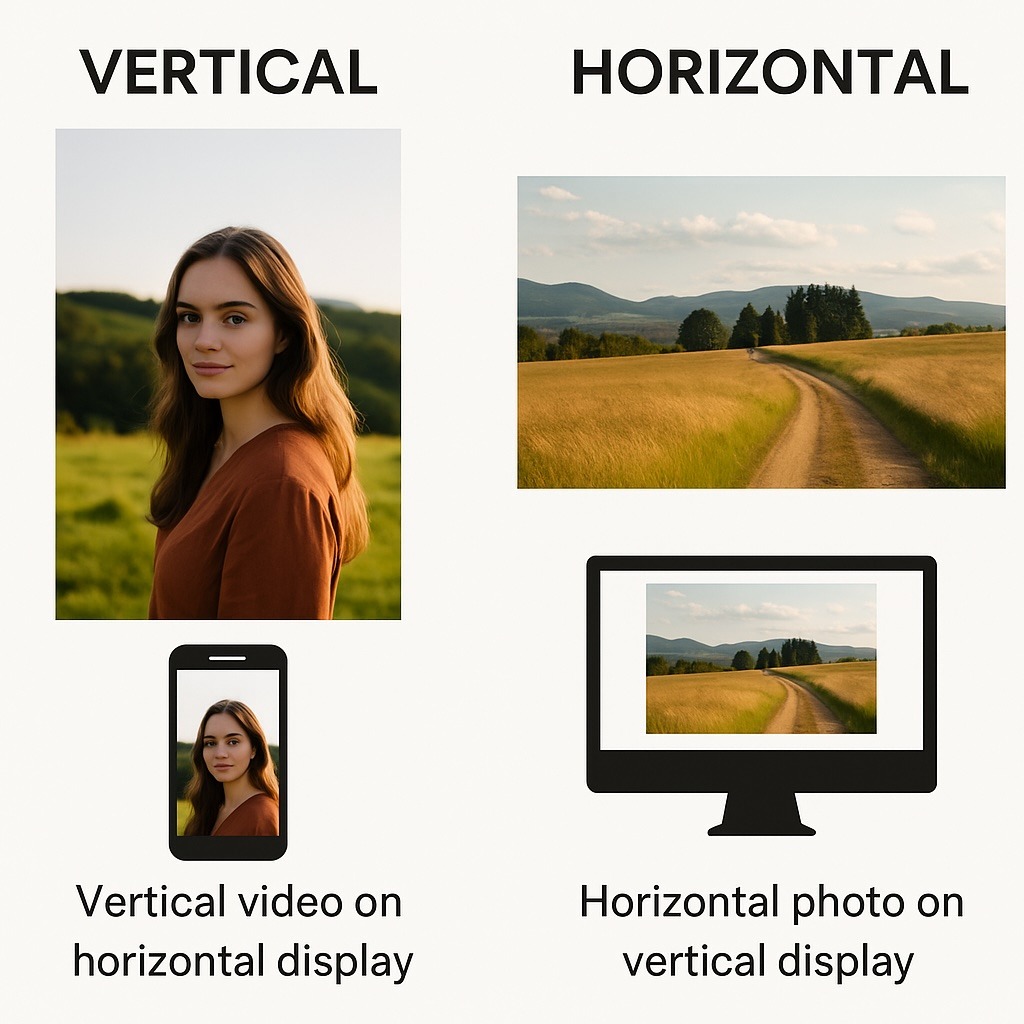
Adopting a format also means accepting its constraints. One vertical video on a horizontal screen (computer, TV) creates two large black bands on each side. Result: loss of impact, feeling empty, reduced image.
On the other hand, landscape photo viewed on smartphone will be seen in small format, sometimes with an unflattering automatic cropping. Content becomes less legible, less immersive. It is therefore necessary to anticipate these effects, especially if the images are intended to be projected, printed, or disseminated on several media.
My professional approach: question before triggering
In time, I realized that the key is not to cut between portrait or landscape, but ask the right question to the client:
« On what medium will you broadcast these images? Who are they addressing? »
It's by knowing End use, the support (smartphone, tablet, website, giant screen), and the destination (social networks, brochure, showcase site) that can be offered the right format from the moment of shooting.
Often, my clients don't know exactly yet what they will do with their images. This is where my role as a photographer makes sense: anticipate, orient, propose the relevant format. Sometimes doubling some catches to provide both versions, especially if the image is to be used for both an Instagram story and a 16:9 virtual tour.
The important thing is to avoid at all costs. Destroying recadrages, content that loses its strength on the screen, or worse, that gives an impression of « DIY ». An attentive and informed photographer will offer the right format At the right time.
Conclusion: beyond format, think about viewing experience
The format is not just an aesthetic choice, it is a narration tool and user experience. In a world where images circulate from a smartphone to a giant screen, where each platform has its own codes, versatility becomes an asset.
Instead of opposing the vertical and the horizontal, we must think them as two complementary visual writings, at the service of your message.
As a photographer, My role is toadapt each shot to its use, taking into account media, dissemination formats, and public expectations. This tailor-made approach is what transforms a simple photo into an image that works, tells, and touches.